
REVIEW · PARIS
Seine River Guided Cruise by Vedettes de Paris
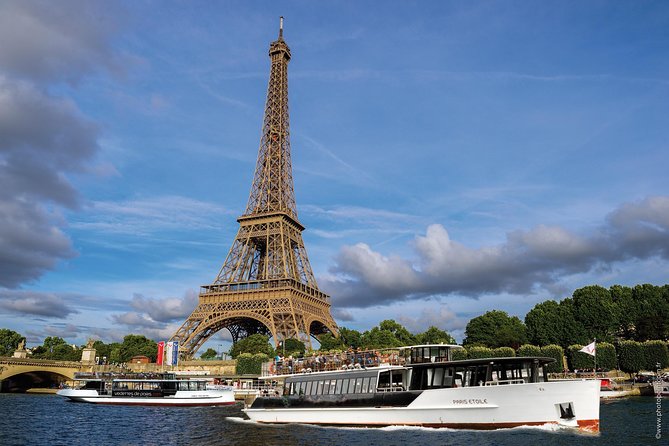
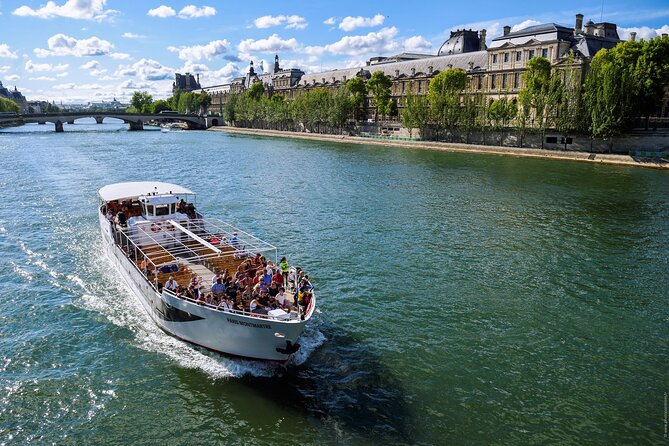
The best part of this cruise is simple: Paris unfolds at river level. From the Seine, the Eiffel Tower, Louvre, Notre-Dame, grand bridges, and riverside palaces line up in one easy hour. You get a useful first look at the city without another long museum visit or uphill walk.
I like the 100% electric boat, which makes for a quieter ride, and the choice of a live guide in English and French rather than relying only on a recording. Guides such as Bernadette and Caterina have been praised for lively, clear explanations. The main drawback is that commentary can be hard to hear from the open upper deck, especially when the guide switches between French and English.
Key points to know before you book
- One hour covers many major sights: You’ll pass the Eiffel Tower, Musée d’Orsay, Louvre, Notre-Dame, Hôtel de Ville, and more.
- The boat is fully electric: The quieter ride helps you hear the guide and take photographs without constant engine noise.
- Live commentary is in English and French: Spanish, Italian, German, and Dutch commentary is available through a free application.
- The best time depends on your goal: Daytime gives clearer photographs, while sunset and evening departures add glowing bridges and monuments.
- Optional extras are available: Choose champagne, or a pancake or cookie with a soft drink, when booking the matching package.
- Port de Suffren is close to the Eiffel Tower: The cruise begins and ends at 2 Port de Suffren in the 7th arrondissement.
Why a Seine cruise is a smart first hour in Paris
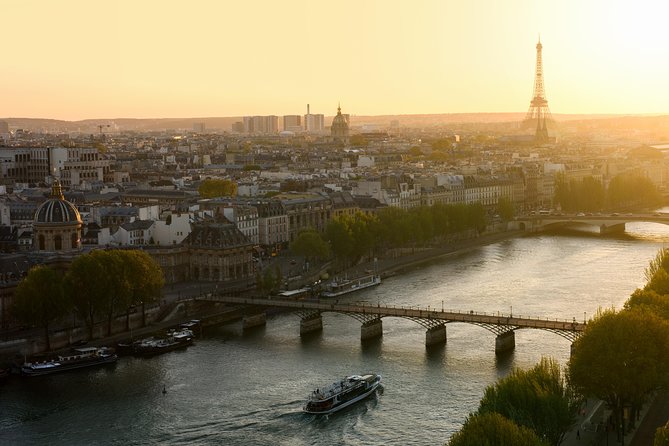
Paris can be tiring on arrival. A river cruise gives you a gentle introduction while you sit down, look around, and hear the basic story of the city. It is also a good way to get your bearings before deciding which monuments deserve more of your time.
At about $25.23 per person, this is not the cheapest activity in Paris, but it is fair value for a one-hour ride past a long list of major sights. You are paying for the boat, the route, the live explanation, and the convenience of seeing much of central Paris without changing trains or walking several miles.
The boat departs from Port de Suffren, beside the Eiffel Tower. That location works well if you are already visiting the tower, the Trocadéro area, or the Invalides. It is also a useful activity after a morning of sightseeing, when you want a quiet break without losing your view of the city.
Departures run throughout the day. A morning cruise may feel calmer and can be a good choice if you want to continue sightseeing afterward. Late afternoon brings warmer light and good photographs. After dark, the illuminated buildings and bridges give the ride a different mood. One especially useful timing idea is to take a late afternoon cruise and then remain near the Eiffel Tower for its evening sparkle.
More Seine cruises in Paris:
- Paris: 1-Hour Seine Cruise departing from the Eiffel Tower
★ 4.4 · 77,472 reviews - Paris: Seine Cruise & Crepe Tasting near the Eiffel Tower
★ 4.4 · 11,231 reviews - Paris: Seine River Panoramic Views Dinner Cruise
★ 4.3 · 10,611 reviews
The electric boat, seating, and sound
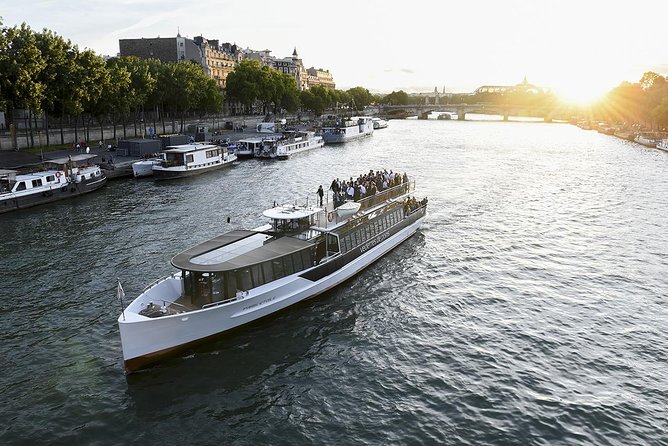
The 100% electric boat is one of the more appealing details here. A quieter motor means less background noise than you might expect on a river tour, and the boat feels modern and clean. Some people also prefer the smaller boat used by Vedettes de Paris to the largest sightseeing vessels on the Seine.
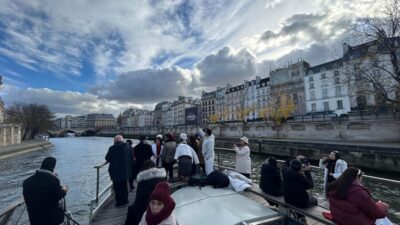
You can usually choose between the open upper deck and indoor seating below. The upper deck offers the best photographs and the widest view, but it can be cold even when Paris feels mild on land. Blankets may be offered in colder weather, though you should still bring a layer if you want to sit outside.
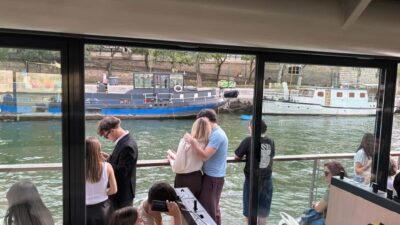
The indoor area is warmer, but windows can limit some photographs. Seats have been described as basic, and the upper-deck chairs may not feel especially luxurious. This is a sightseeing boat, not a fine dining vessel, so keep your expectations practical.
Sound is the main point to watch. Many rides have clear, easy-to-follow explanations, but some people find the English and French narration difficult to hear outdoors. If hearing every detail matters to you, sit closer to the guide or choose the indoor area. The free application provides commentary in Spanish, Italian, German, and Dutch.
The live guide adds personality that a recording cannot always provide. The guide may point out a bridge detail, suggest a good photograph, or adjust the pace for the group. Bernadette and Caterina are among the guides associated with particularly engaging tours, although your guide will depend on the departure.
From the Eiffel Tower to the Invalides
The cruise begins with the Eiffel Tower, one of the strongest photo moments of the hour. Gustave Eiffel’s iron tower was built for the 1889 Universal Exhibition in just two years, two months, and five days. It rises 324 meters and weighs about 7,300 tonnes.
The tower was meant to last only 20 years. A radio antenna added in 1903 helped save it from demolition, and it later became the symbol of Paris. From the water, you get a broad view of its full structure, which is often more satisfying than seeing only its base from a crowded plaza.
The boat also passes the new Russian Orthodox Holy Trinity Cathedral. Its complex includes a bilingual Franco-Russian school, parish house, and cultural centre. It is a quieter sight than the Eiffel Tower, but it gives you a glimpse of modern religious and cultural connections in Paris.
Look for the green clock tower of the American Church in Paris. It was the first American church built outside the United States, and its stained-glass windows by Louis Comfort Tiffany are listed as a historic monument.
The Hôtel des Invalides comes next as a major golden-domed landmark. Louis XIV ordered it as a military hospital for injured soldiers and officers. Today, the royal chapel contains the tomb of Napoleon I. The dome is easy to recognize from the river, and the guide’s explanation helps connect the grand building with France’s military past.
Bridges built for alliances, revolutions, and royal power
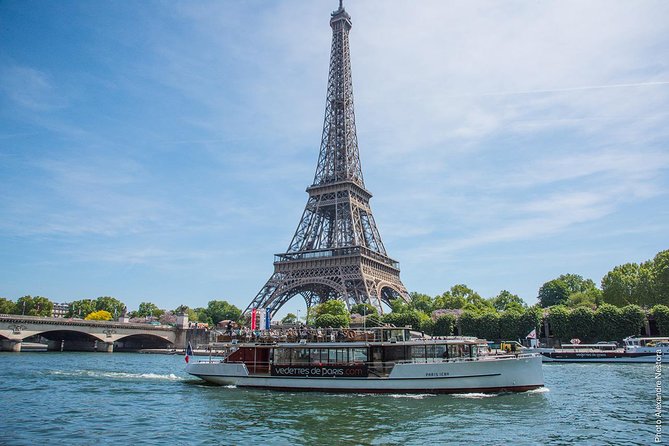
The Seine is not just a route between monuments. Its bridges tell much of Paris’s political story.
The Pont Alexandre III was built for the 1900 Universal Exhibition and to mark the Franco-Russian Alliance. Its decoration includes the Paris coat of arms in gold leaf, along with nymphs representing the Seine. On the opposite side are symbols connected with Saint Petersburg and the Neva River.
The Pont de la Concorde has a more revolutionary story. Its stones came from the former Bastille prison, stormed in 1789. The bridge leads toward the Palais Bourbon, home of the National Assembly, and Place de la Concorde. This is a good example of how the cruise links grand architecture with major events in French history.
You will also see the green dome of the Hôtel de Salm, now the Légion d’honneur Palace. The Légion d’honneur is France’s highest honour. From the boat, you get the exterior view, not an interior visit, but the guide gives you enough context to make the building memorable.
The former Orsay railway station is one of the river’s most rewarding sights. Built for the 1900 exhibition, it once served trains heading southwest from Paris. In the 1980s, it became the Musée d’Orsay, home to 19th-century art by painters such as Renoir, Monet, and Van Gogh.
If you plan to visit the Musée d’Orsay, note its riverside position during the cruise. The boat will not replace a museum visit, but it helps you understand the building before you enter. Seeing its huge clock and former station structure from the river is part of the pleasure.
More guided river trips in Paris:
- Paris: Catacombs Entry & Seine River Cruise with Audio Guide
★ 4.4 · 1,150 reviews - Paris: Catacombs, Audio Guide, and River Cruise Option
★ 4.6 · 966 reviews - Paris Seine River Sightseeing Guided Cruise Vedettes du Pont Neuf
★ 4.0 · 718 reviews - Paris: Family-Friendly River Seine Guided Cruise
★ 4.3 · 359 reviews
The oldest bridge and the heart of old Paris
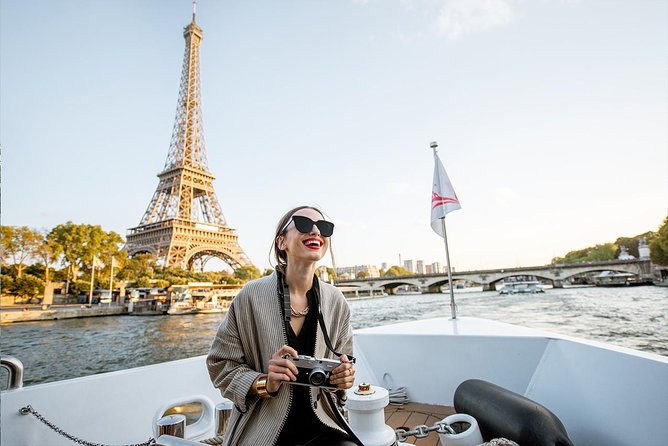
The Institut de France occupies the former Collège des Quatre Nations, built with money left by Cardinal Mazarin in 1661. It houses five academies, including the Académie Française, whose members help update the official French dictionary.
Then comes the Pont Neuf, which is actually Paris’s oldest bridge. The name means New Bridge, a reminder that names can outlast the buildings that inspired them. It was the first Parisian bridge built in stone with pavements and no houses along its sides.
Look closely at its 381 grimacing stone masks. Each one is individually decorated and different. From the river, you may not see every face, but the bridge’s ornate design is easy to appreciate from below.
Pont Saint-Michel was built at the request of Napoleon III. Its pillars carry two imperial Ns. From this point, you can look toward the Latin Quarter, named because students at the University of Paris spoke Latin there until the 19th century.
The cruise then reaches Île de la Cité, one of Paris’s two natural islands and the traditional birthplace of the city. The Parisii tribe settled here roughly 300 years before the Common Era and called the island Lutetia. The island remains the historical centre of Paris, and the river view makes its position easy to understand.
Notre-Dame, the Louvre, and Paris’s grandest river views
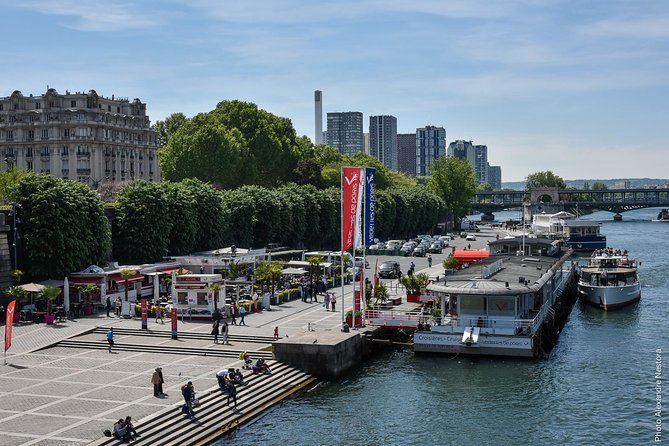
Notre-Dame Cathedral is the emotional centre of this part of the cruise. Construction began in 1163 and took almost two centuries, finishing in 1345. From the Seine, you can see its Gothic mass, towers, sculptures, and gargoyles from an angle that is difficult to get from the surrounding streets.
The south rose window, called the Rose du Midi, is dedicated to the New Testament and was given by King Saint Louis. The guide may also point out the statue of Saint Geneviève, patron saint of Paris, with her back toward the river. Sculptor Paul Landowski later created Christ the Redeemer in Rio de Janeiro.
Nearby, the Arab World Institute combines cultural programming with a striking modern exterior. It opened in 1987 under President François Mitterrand and focuses on the history, art, society, religions, and science of the Arab world.
Île Saint-Louis offers a softer contrast. Its 17th-century town houses, including the Hôtel Lambert and Hôtel Lauzun, make it one of the city’s most prestigious residential areas. Writers and musicians including Charles Baudelaire and Georges Moustaki once lived there.
The Hôtel de Ville has been the seat of Paris’s city council since 1357. Its Neo-Renaissance design is best appreciated from the water, where the large façade can be seen without the distractions of the surrounding streets. The interior includes a banquet hall modeled on the Hall of Mirrors at Versailles, though this cruise only gives you the outside view.
The Conciergerie tells a darker story. Built under Philip IV in the 14th century, it later became a prison. Marie-Antoinette spent her final two months there before her execution at Place de la Concorde in 1793.
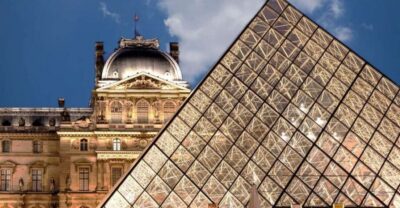
The Louvre follows, and its scale is hard to grasp from the street. It began as a royal palace and became a museum in 1793. With more than four kilometres of façades and nearly 14 kilometres of galleries, it is one of the largest museum complexes in the world.
The river view does not show you the Mona Lisa, Venus de Milo, or Winged Victory of Samothrace, of course. What it does show is the Louvre’s long palace frontage and its place along the Seine. The famous glass pyramid is another memorable sight, especially for a first visit to Paris.
Place de la Concorde, the Grand Palais, and Trocadéro
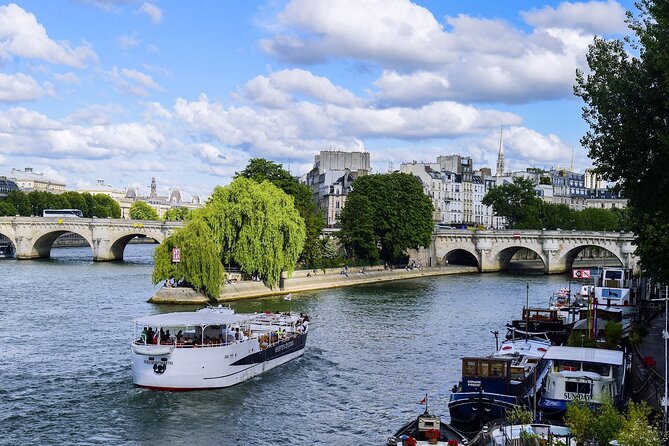
Place de la Concorde carries both royal and revolutionary history. Louis XVI and Marie-Antoinette were executed here during the French Revolution. The centrepiece is a 34-century-old Egyptian obelisk from Luxor, brought to France in 1836.
The Grand Palais comes into view near the end of the route. Built for the 1900 Universal Exhibition, it is known for its enormous glass roof, considered the largest in Europe. Today it hosts exhibitions, cultural events, a funfair, and a large skating rink.
The Flame of Liberty is an exact copy of the Statue of Liberty’s flame in New York. It was given by the United States and the International Herald Tribune in thanks for France’s work restoring the Statue of Liberty. The sculpture became widely known because of its location near the tunnel where Princess Diana died, though the cruise focuses on its official origin.
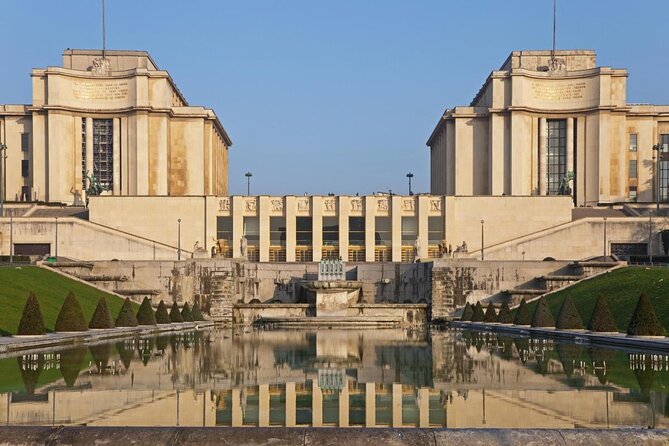
The final major sight is the Palais de Chaillot at Trocadéro. Built for the 1937 Universal Exhibition, it has two Neoclassical wings facing an esplanade above the Trocadéro gardens. Its museums include the City of Architecture and Heritage, the National Navy Museum, and the Museum of Humankind, along with the National Theatre of Chaillot.
The route ends back at the meeting point. That makes the cruise easy to pair with another activity near the Eiffel Tower, and you do not need to arrange a separate ride back across Paris.
Champagne, snacks, and the practical value of upgrades
The basic cruise does not include food or drinks. You can buy optional packages with a glass of champagne, or a pancake or cookie with a soft drink. These extras make sense if you want a small treat during an evening ride, but they are not necessary for enjoying the sights.
Check your booking carefully for the exact package. Drink vouchers may be sent by email, and it is easy to overlook them. Champagne is available only to adults. If children are joining you, separate bookings are required when selecting the champagne option.
There is no baggage storage on board, so bring only what you need for the hour. The boat has toilets, but the toilets at the dock are operated separately and may require a café receipt or payment. The cruise accepts a maximum of 220 people, while groups over 14 participants are not accepted as a group booking.
Free cancellation is available up to 24 hours before the scheduled start time. Poor weather can also lead to a cancellation, in which case you are offered another date or a full refund. Changes made less than 24 hours before departure are not accepted.
Who should book this Seine cruise?
I would recommend this cruise for a first visit to Paris, families, couples, and anyone who wants a low-effort hour between major sights. It also suits you if you want a clear look at the city before choosing which museums and monuments to visit in depth.
It is especially useful after arrival, when you may be tired but still want to see Paris. The one-hour length is long enough to cover the major river sights and short enough to fit into a busy schedule.
You may want another option if you need a quiet, highly polished dining experience, guaranteed outdoor seating, or detailed commentary in a language other than English or French without using an application. Sound can also be uneven, so anyone who depends on every spoken detail should sit near the guide.
For the best balance, choose a daytime or late-afternoon departure for photographs. Pick an evening departure if you care more about glowing monuments than architectural detail. Add champagne or a snack only if that small extra matches the mood you want.
FAQ
Where does the Seine cruise begin and end?
It begins at V75R+HJ7, 2 Port de Suffren, 75007 Paris, France. The cruise ends back at the same meeting point.
How long is the cruise?
The cruise lasts approximately one hour.
What languages are available?
Live commentary is provided in English and French. A free application offers commentary in Spanish, Italian, German, and Dutch.
Is food or drink included?
Food and drinks are not included in the standard cruise. Optional packages include a glass of champagne, or a pancake or cookie with a soft drink.
Can children join the champagne option?
The champagne option is available only for adults. If children are included in your party, you must create two separate bookings when selecting that option.
Can I cancel for a full refund?
Yes. You can cancel up to 24 hours before the experience start time for a full refund. Cancellations or changes made less than 24 hours before departure are not accepted.
Just added around Paris
- The Official Emily in Paris Champagne Seine Cruise★ 4.9 · 27 reviews
- Paris: Seine Cruise with Snack/Optional Eiffel Tower Ticket★ 4.2 · 210 reviews
- Paris: Bastille Day Dinner Cruise on the Seine River★ 4.1 · 84 reviews
- Paris: The Rodin Museum and Seine River Cruise★ 4.6 · 45 reviews
- Paris: Seine River Private Guided Pontoon Boat Cruise★ 5.0 · 133 reviews
- Paris: Loire Valley Castles Tour with Wine Tasting★ 4.9 · 22 reviews
- Paris: Seine River Dinner Cruise with Live Music★ 3.6 · 18 reviews
- Paris: Sightseeing Cruise on the Seine with 3-Course Lunch★ 4.6 · 33 reviews
Paris River Cruises, compared.
1-Hour Seine Cruise departing from the Eiffel Tower
Read our review →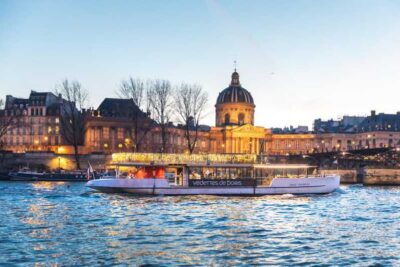
Illuminations River Cruise with Audio Commentary
Read our review →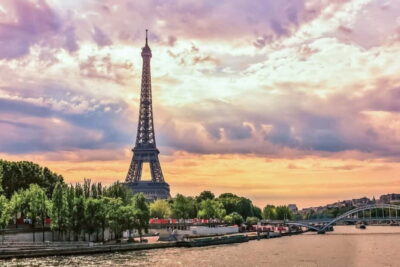
Seine Cruise & Crepe Tasting near the Eiffel Tower
Read our review →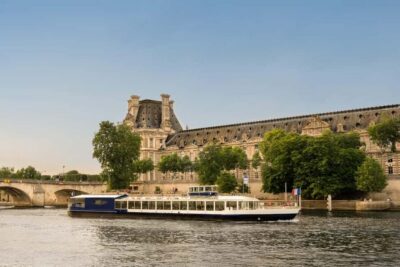
Louvre Museum Entry Ticket With Host and River Cruise
Read our review →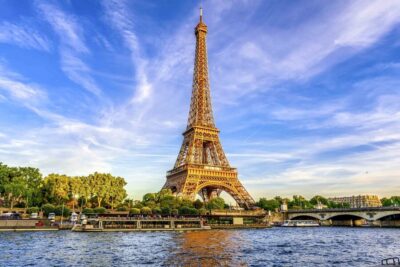
Eiffel Tower Access by Elevator & Seine River Cruise
Read our review →
3-Course-Dinner Cruise on the Seine with live music
Read our review →Browse the lists this tour appears in