
REVIEW · PARIS
Paris: Big Bus Hop-on Hop-off Tour and Seine River Cruise
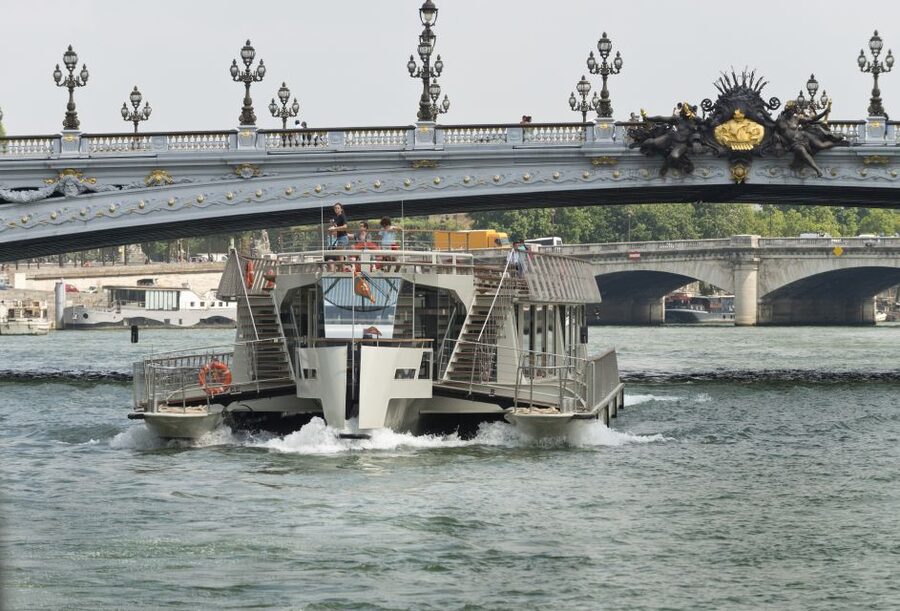
Paris makes a fine first impression from the top deck of a Big Bus, but the one-hour Seine cruise gives you the better sense of the city’s grand design. You pass Notre Dame, the Musée d’Orsay, the Eiffel Tower, and a chain of handsome bridges without fighting traffic or foot traffic.
I like the freedom to build your own day, and I like the coverage. The route reaches the Louvre, Champs-Elysées, Invalides, the Eiffel Tower, and Notre Dame, while the audio guide fills in useful background as Paris rolls past. The main drawback is time: traffic, queues, and crowded buses can turn a simple three-stop ride into a slow outing.
Key points at a glance
- A useful first-day overview: Ride the full route before choosing where to spend more time.
- Two ways to see Paris: The bus shows the avenues and monuments, while the cruise frames them from the Seine.
- Ten practical hop-on points: Stops cover the Louvre, Notre Dame, Musée d’Orsay, Champs-Elysées, Eiffel Tower, Invalides, and Opéra Garnier.
- Choose 24 or 48 hours: The longer pass works best if you want transport and sightseeing spread over two days.
- Plan around traffic and queues: Bus times are not fixed, and the cruise can become especially crowded.
- Good for families and limited mobility: All buses have wheelchair ramps, and the ride cuts down on long walks.
The best way to use the bus and boat together
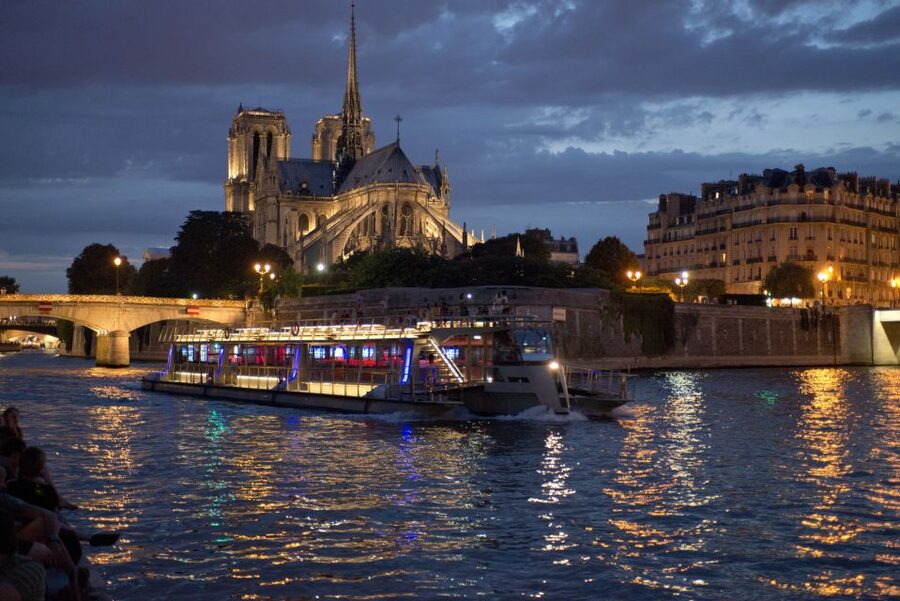
This is not a guided walking tour with a fixed script. It is a moving introduction to Paris, with the choice to get off whenever a museum, monument, or neighborhood catches your eye.
I would use the bus early in your visit. Ride a large part of the route first, listen to the commentary, and note the places you want to revisit on foot. Then use the pass as a practical link between major sights. Paris is walkable in sections, but the distances between the Louvre, Eiffel Tower, and Arc de Triomphe can eat up a good part of your day.
The cruise works best as a separate chapter, not as something to squeeze into a spare 30 minutes. It leaves from Pontoon No. 3 at Port de la Bourdonnais, close to the Eiffel Tower stop. Boats run every 45 minutes from 10:30 a.m. to 9 p.m., with departures every 30 minutes on weekends, but you still need to choose a time slot before boarding.
The combination is especially handy if you are visiting Paris for only a day or two. You get the broad view from the bus, the postcard view from the water, and the chance to step off for the sights that matter most to you.
More Seine cruises in Paris:
- Paris: 1-Hour Seine Cruise departing from the Eiffel Tower
★ 4.4 · 77,472 reviews - Paris: Seine Cruise & Crepe Tasting near the Eiffel Tower
★ 4.4 · 11,231 reviews - Paris: Seine River Panoramic Views Dinner Cruise
★ 4.3 · 10,611 reviews
What the 24-hour and 48-hour passes really offer
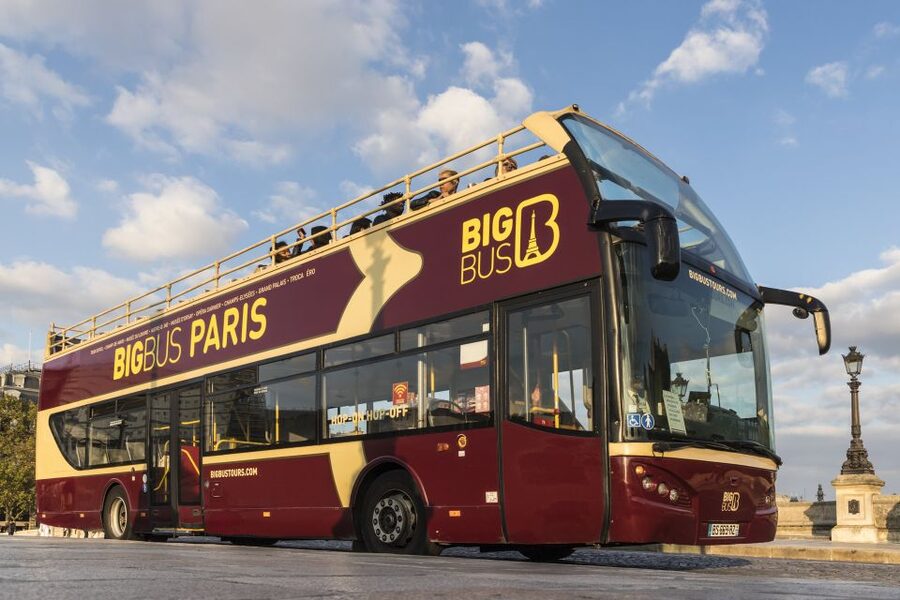
At $61 per person, this is not the cheapest way to move around Paris. Its value comes from combining sightseeing, commentary, and transport rather than from unlimited rides alone.
The 24-hour pass suits a first-time visitor who wants a structured introduction. You could ride in the morning, stop at the Louvre or Notre Dame, continue toward the Eiffel Tower, and use the cruise later that day. A second ride after dark can add another angle, although bus operating hours and traffic make late plans less predictable.
The 48-hour pass gives you breathing room. You can use one day for the western side of the route, including the Champs-Elysées, Arc de Triomphe, Grand Palais, and Eiffel Tower. On the second day, focus on the Louvre, Notre Dame, Musée d’Orsay, Opéra, and Invalides. This is a better fit if you want to visit museums instead of simply photographing their exteriors.
The pass does not include hotel pickup, and it is not a fast substitute for the Paris Métro. Traffic can be slow, especially around major avenues and intersections. I would not book this as your only plan if you need to reach a timed museum entry or a train station at a precise hour.
Starting at Louvre-Pyramide
The information centre at 11 Avenue de l’Opéra is the clearest starting point if you want help activating the ticket. You can also board at any listed Big Bus stop by showing your mobile or printed voucher to a staff member.
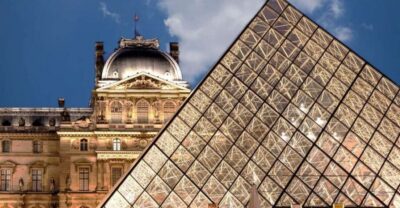
From the Louvre-Pyramide stop, the route puts you close to the Louvre complex and the formal streets around the Palais Royal and Opéra. This is a useful opening because the Louvre itself can take half a day or more, while the bus gives you a quick sense of how it fits into central Paris.
The nearby Louvre and Pont des Arts stop at 56 Quai François Mitterand is better for reaching the riverfront. From here, you can look across toward the Institut de France and cross the Seine on foot if you want to connect the museum district with Saint-Germain-des-Prés.
Do not confuse riding past the Louvre with visiting it. The bus gives you orientation, not museum admission, and you will need separate planning for entry.
Notre Dame and the Musée d’Orsay
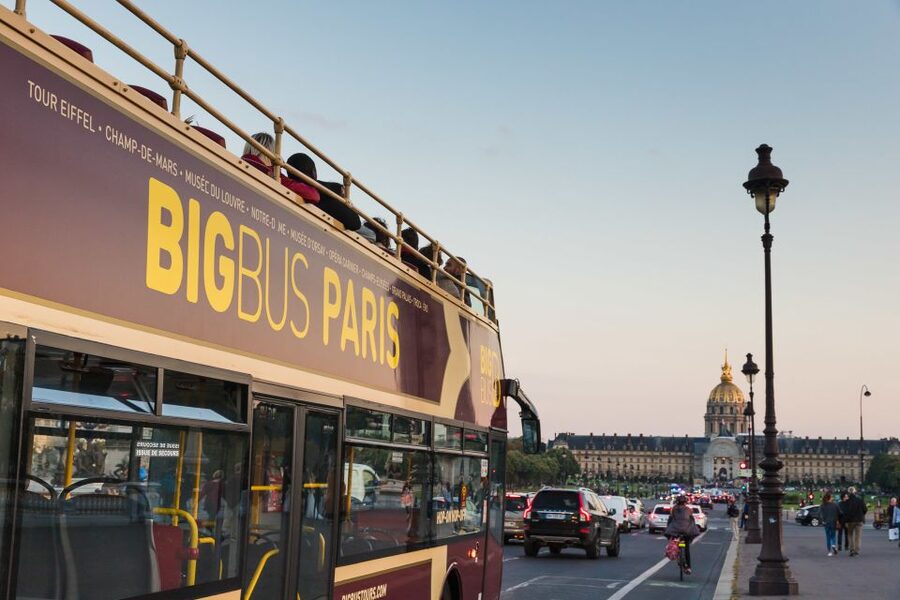
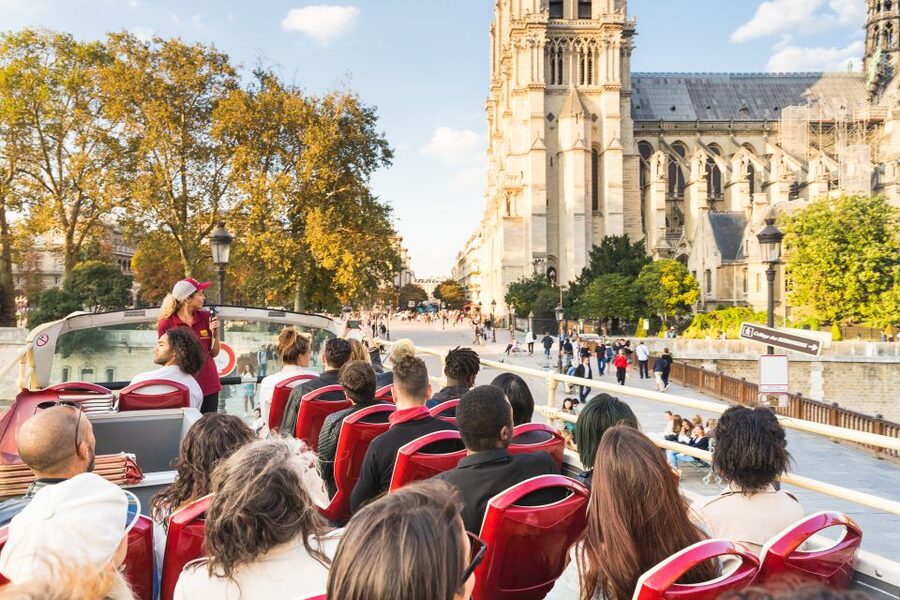
The Notre Dame stop at 3 Rue Lagrange places you near the eastern end of Île de la Cité. This is one of the most useful stops for seeing the cathedral area, the Seine quays, and the historic center on foot.
The bus cannot replace a walk here. Streets around the island and nearby Latin Quarter reward slow wandering, while the route itself gives you the broad view. Listen to the audio commentary during this stretch, then get off if you want to explore the riverbanks and surrounding streets.
At 58 Place Henry de Montherlant, the Musée d’Orsay stop serves the former railway station turned art museum. The museum is known for its nineteenth-century paintings and sculpture, but the stop is also handy for crossing toward the Tuileries and the Louvre.
This is a good place to split the day. You can visit the Musée d’Orsay, return to the stop, and continue by bus. Build in extra time, since the next bus depends on traffic and the route can become crowded.
A few more river trips around Paris worth comparing
- Paris: Evening River Cruise with Music
★ 4.4 · 22,721 reviews - Paris: Illuminations River Cruise with Audio Commentary
★ 4.3 · 12,340 reviews - Paris: Louvre Museum Entry Ticket With Host and River Cruise
★ 4.6 · 9,926 reviews - Paris: Eiffel Tower Access by Elevator & Seine River Cruise
★ 4.6 · 7,329 reviews
Champs-Elysées, Grand Palais, and the Arc de Triomphe
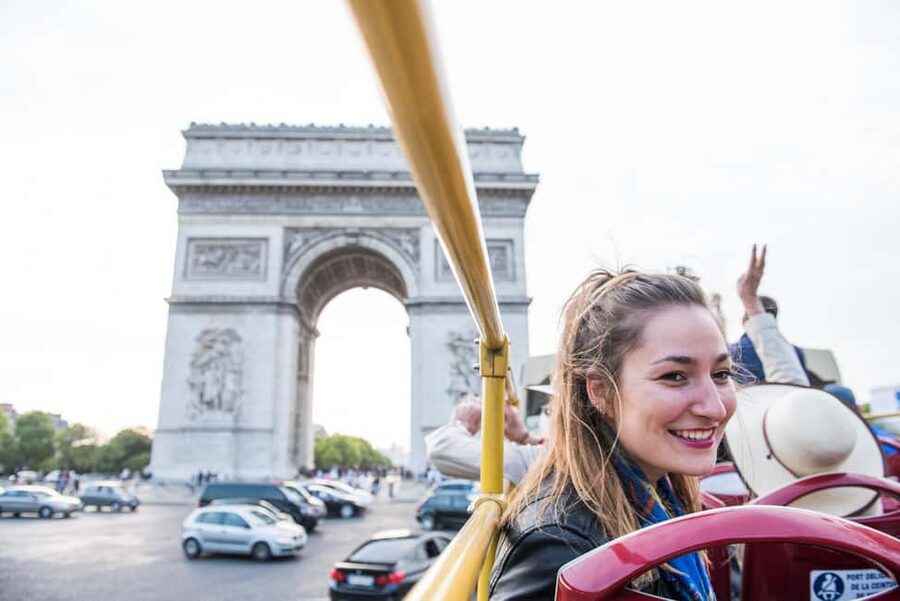
The Champs-Elysées stop at 156 Avenue des Champs-Elysées places you on one of Paris’s most famous avenues. This stretch is wide, ceremonial, and built for grand views, although it can feel more commercial than traditionally Parisian.
The route continues to the Grand Palais on Avenue Winston Churchill. From here, you are close to the Seine, the Petit Palais, and the broad open space around the Invalides side of the city. The stop is useful if you want a short walk between major monuments without committing to a long cross-town trek.
The Arc de Triomphe is one of the headline sights even though the listed stop is described as Champs-Elysées rather than as a separate Arc stop. You can see the monument from the route, but confirm with the staff where to get off for the most convenient approach on the day. Paris traffic and temporary road changes can affect the exact stopping pattern.
This is also where the open-top deck gives you some of its best city views. You see the avenues radiating away from the Arc, a layout that is much easier to understand from above street level.
Eiffel Tower, Champ de Mars, and the Seine cruise
The Eiffel Tower stop is at Quai Branly, near Entrance 2 of the tower. The Champ de Mars stop on Avenue Joseph Bouvard offers another nearby option, with access to the broad lawn and the classic tower viewing area.
I would pair these stops with the cruise, but not assume you can step off the bus and board immediately. The cruise leaves from Pontoon No. 3 at Port de la Bourdonnais, near the Eiffel Tower stop. You must select a departure time before boarding through the app, website, or a Big Bus staff member.
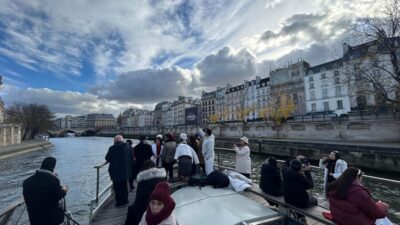
The boat ride lasts one hour. From the water, Paris feels less like a collection of separate sights and more like one connected city. You pass under bridges and see Notre Dame, the Musée d’Orsay, and other major monuments from a lower, quieter viewpoint.
Evening departures can be especially attractive when the city lights come on, but they are also popular. At busy times, the line for a boat can be long, and one report described a 60 to 90 minute wait. Choose your slot early and leave plenty of room around it.
The cruise has its own commentary, and it is separate from the bus audio. Keep your cruise confirmation or ticket details handy. A past passenger had to retrieve the cruise ticket again after leaving it behind, a small problem that is easy to avoid.
Invalides and Opéra Garnier
The Invalides stop at 2 Avenue de Tourville brings you close to the golden-domed complex associated with Napoleon and France’s military history. It is also a good jumping-off point for the surrounding grand avenues and museums.
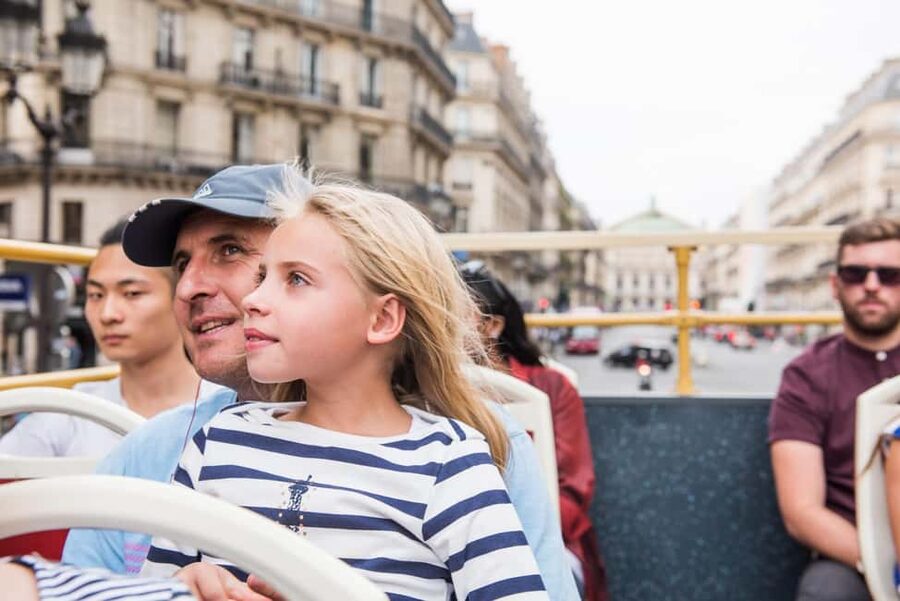
The Opéra Garnier stop, facing 15 Rue Scribe, places you near the ornate nineteenth-century opera house, department stores, and central shopping streets. This stop gives the route a useful contrast: Paris is not only museums and monuments, but also grand commercial streets and elaborate public buildings.
These stops are valuable on a 48-hour pass because they let you spread out your sightseeing. On a single day, you may prefer to stay with the Louvre, Notre Dame, Eiffel Tower, and cruise rather than chase every stop.
Audio commentary, buses, and the view from the top
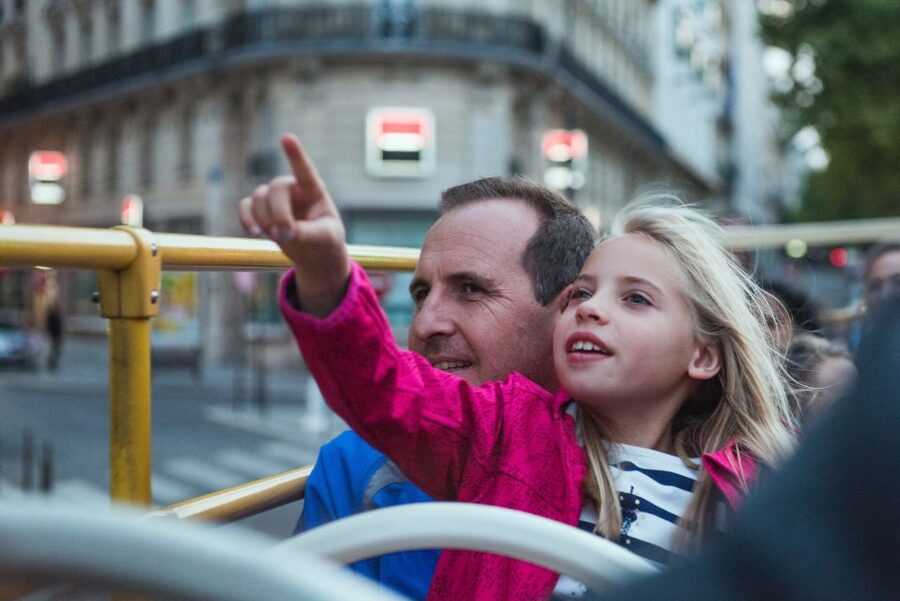
Headphones are provided, and the digital commentary is offered in Spanish, Chinese, English, French, German, Italian, Portuguese, Russian, and Korean. The commentary gives structure to what you are seeing, which matters when a monument appears for only a few minutes before the bus turns a corner.
The bus also has WiFi, and the downloadable Big Bus app provides live tracking. I would use the app before leaving a stop, especially if you are trying to coordinate the cruise or a museum entry.
The sound quality can vary by bus. One issue reported on a departure was commentary that did not match the location, while another bus had a faulty headphone connection. If the audio is not working, change seats or ask the staff when you get off. The buses themselves were generally described as clean and frequent, but frequency does not remove the effect of Paris traffic.
The open top is wonderful in clear weather and less appealing in rain or cold. Some passengers specifically wanted more cover during wet or snowy weather. Bring a layer even in mild conditions, and keep your phone secure when the bus turns or brakes.
Crowds, queues, and realistic timing
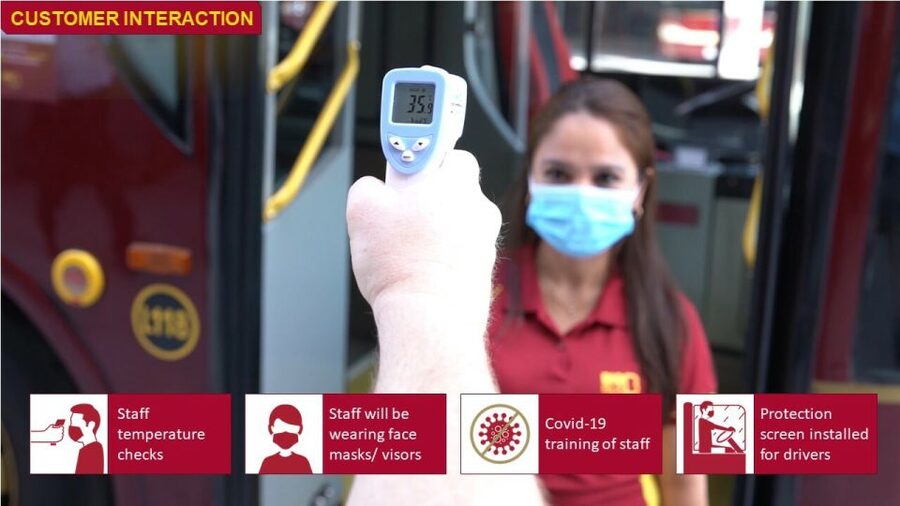
The biggest mistake is treating the printed route as a timetable. Paris traffic can make a short section surprisingly slow, and one especially delayed bus took around 45 minutes to cover three stops. A later bus may feel much faster, so allow a generous margin.
Queues affect the cruise as well as the road. The boat may be crowded, with large groups waiting for the same departure. If your cruise time matters, arrive early and avoid placing a timed attraction immediately afterward.
The bus can also fill up at popular stops. If the top deck matters to you, board early in the day or be ready to accept an indoor seat. The audio and views still work from below, but the open-air perspective is a major part of the appeal.
I would not plan more than two major indoor attractions around the bus on one day. The pass works best when you leave room for traffic, photos, food, and the occasional unscheduled stop.
Families, older adults, and wheelchair users
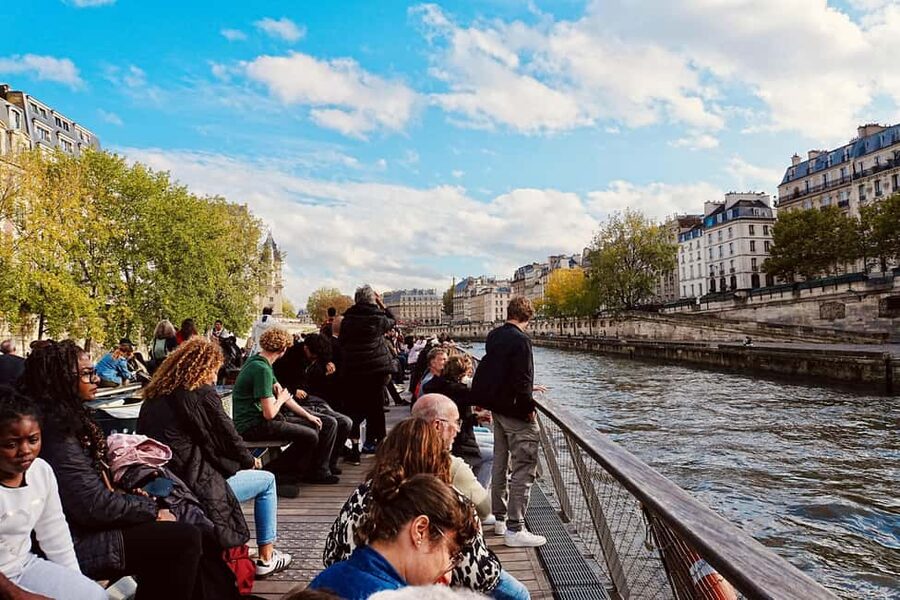
This tour is a strong option for families with children because it reduces long walks between distant sights. It also gives children a changing view rather than another museum room, and the freedom to get off can prevent the day from feeling too rigid.
It can suit an older adult who would find a full day of walking tiring. One useful approach is to ride in the morning, stop for lunch, and continue later rather than trying to complete the whole route at once.
All buses have a ramp for wheelchair access, and the activity is listed as wheelchair accessible. You should still speak with staff at the stop if you need help boarding or want to confirm the best place to wait.
The cruise adds a seated break, though boarding areas and crowd levels can vary. If mobility is a concern, allow more time than the basic departure interval suggests.
Booking, activation, and flexibility
You can activate the ticket in the Big Bus app with the Activity Provider Reference Number, or visit the information centre at 11 Avenue de l’Opéra. Staff at the stops can also help activate it when you show your voucher.
The app is worth downloading for three reasons: live bus tracking, ticket activation, and cruise time selection. If you prefer not to use the app, the website and Big Bus staff can handle the cruise booking.
The activity allows cancellation up to 24 hours before the start time for a full refund, and you can reserve now and pay later. That flexibility helps if your Paris schedule is still shifting.
Who should book this Paris combination?
I would book it if you are visiting Paris for the first time, have limited time, are traveling with children or an older companion, or want a low-effort way to connect far-flung sights. It is also useful if you prefer commentary and orientation before exploring on foot.
I would be less keen if you already know Paris well, dislike fixed sightseeing vehicles, or need precise travel times. The Métro and walking can be faster, while a dedicated museum or walking tour may give you more depth at one location.
The strongest plan is simple: use the bus for orientation, choose one or two key stops, and reserve the cruise early. At $61, the ticket earns its keep when you use both parts and take advantage of the 48-hour option. If you only ride once and skip the boat, the value is much weaker.
FAQ
How long is the Seine River cruise?
The cruise lasts one hour.
Where does the Seine cruise depart?
It departs from Pontoon No. 3 at Port de la Bourdonnais, near Big Bus Stop 8 at the Eiffel Tower.
How often do the cruise boats depart?
Departures are every 45 minutes from 10:30 a.m. to 9 p.m. On weekends, they run every 30 minutes.
Can I start the bus tour at any stop?
Yes. You can begin at any Big Bus stop along the route. The listed route has 10 available stops.
Is the tour available in different languages?
Yes. The digital bus commentary is available in Spanish, Chinese, English, French, German, Italian, Portuguese, Russian, and Korean.
Is the bus wheelchair accessible?
Yes. All buses have a ramp for wheelchair access.
Just added around Paris
- The Official Emily in Paris Champagne Seine Cruise★ 4.9 · 27 reviews
- Paris: Seine Cruise with Snack/Optional Eiffel Tower Ticket★ 4.2 · 210 reviews
- Paris: Bastille Day Dinner Cruise on the Seine River★ 4.1 · 84 reviews
- Paris: The Rodin Museum and Seine River Cruise★ 4.6 · 45 reviews
- Paris: Seine River Private Guided Pontoon Boat Cruise★ 5.0 · 133 reviews
- Paris: Loire Valley Castles Tour with Wine Tasting★ 4.9 · 22 reviews
- Paris: Sightseeing Cruise on the Seine with 3-Course Lunch★ 4.6 · 33 reviews
- Paris: Seine River Dinner Cruise with Live Music★ 3.6 · 18 reviews
Paris River Cruises, compared.
1-Hour Seine Cruise departing from the Eiffel Tower
Read our review →
Illuminations River Cruise with Audio Commentary
Read our review →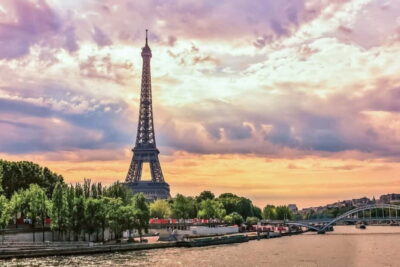
Seine Cruise & Crepe Tasting near the Eiffel Tower
Read our review →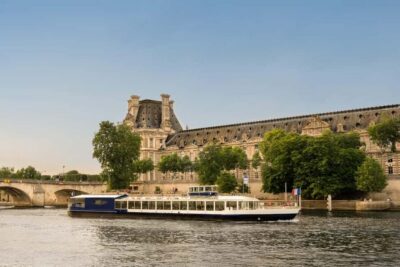
Louvre Museum Entry Ticket With Host and River Cruise
Read our review →
Eiffel Tower Access by Elevator & Seine River Cruise
Read our review →
3-Course-Dinner Cruise on the Seine with live music
Read our review →Browse the lists this tour appears in