
REVIEW · CHICAGO
Chicago Architecture Center River Cruise aboard First Lady
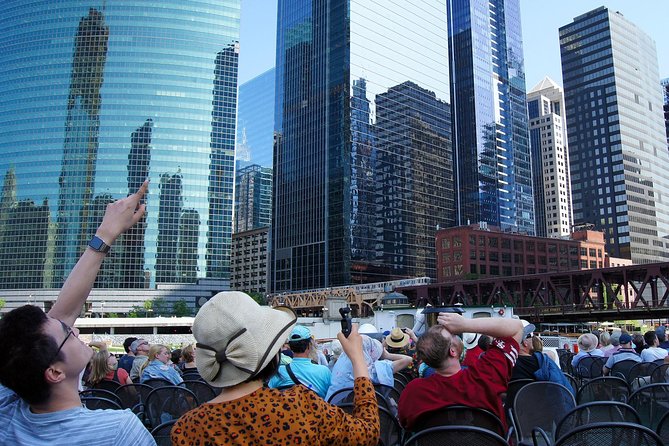
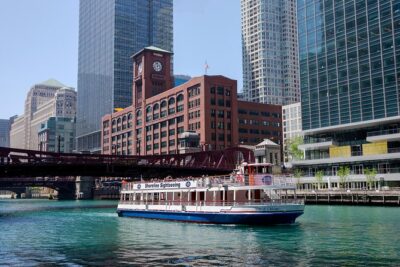
Chicago’s best architecture tour puts you at water level, where the city’s towers rise straight from the riverbanks. In 90 minutes aboard First Lady, you’ll hear how industry, transport, engineering, and urban change shaped Chicago, while your docent points out buildings that can be hard to understand from the street.
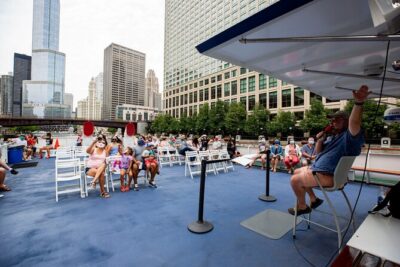
I like the excellent docent guides, who turn glass, steel, concrete, and old warehouses into a readable story. I also like the two-level boat, which gives you open-air views when the weather behaves and a warm, climate-controlled salon when it does not.
The main drawback is simple: seating is first come, first served, and the boat runs in all weather. Arrive at least 30 minutes early, dress for wind and shade, and remember that your ticket cannot be switched to another departure.
Key points before you book
- A 90-minute introduction to Chicago: You cover a large stretch of the river and see major buildings without spending hours on foot.
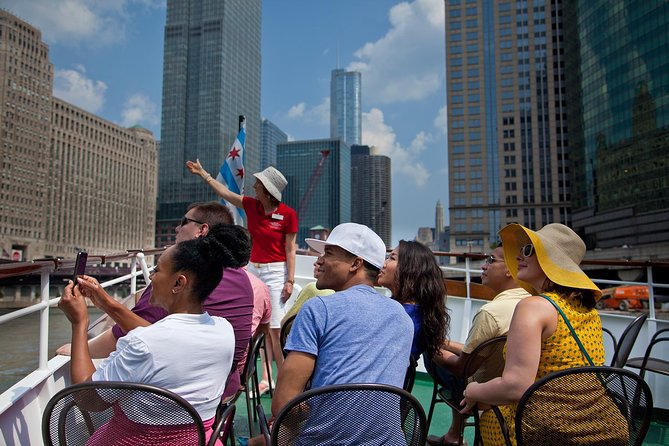
- Docents make the difference: Guides such as Cynthia, Laura, Amy, Russell, Nick, and Mark have led recent departures, though your guide will vary.
- Best views come from the open deck: Bring sunglasses and a cap, but use the enclosed lower salon if rain, cold, or strong sun gets in the way.
- General admission seating: Printed seat numbers are not valid. Early arrival matters if you want a particular side or outdoor spot.
- A full bar is onboard: Drinks and light snacks cost extra, and the boat also has restrooms.
- Easy to pair with downtown sights: The dock is near Michigan Avenue, the Magnificent Mile, Millennium Park, and the Chicago Architecture Center.
Why the Chicago River tells Chicago’s story
The cruise is not just a skyline ride. The river explains why Chicago became Chicago.
From the boat, you see the waterway as an old working corridor that has passed through industry, shipping, transport, cleanup, and recreation. The city’s buildings make more sense when you view them from the river. Towers crowd the banks because the river helped shape the central business district, while older industrial structures reveal a less polished chapter of the city’s past.
That broader story is what separates this cruise from a simple sightseeing boat. You are not only looking up at tall buildings. You are learning why they were built where they are, how their designs respond to neighboring structures, and how Chicago changed as people and businesses moved between city and suburb.
I recommend taking this early in your Chicago visit. The cruise gives you a useful mental map, so later, when you walk along Wacker Drive or look toward the river from a bridge, you can connect the buildings to their architects, dates, and purposes.
The boat leaves from 112 East Wacker Drive, at the Riverwalk dock. The entrance is at street level near the northeast corner of Michigan Avenue and Wacker Drive, about three blocks north of Millennium Park. The Chicago Architecture Center is directly across Wacker Drive, and your cruise ticket can get you discounted admission there for $5 per person.
A few more river trips around Chicago worth comparing
- Chicago Architecture River Cruise
★ 5.0 · 15,756 reviews - Chicago River 90-Minute Architecture Tour
★ 4.5 · 9,629 reviews - Chicago River: 1.5-Hour Guided Architecture Cruise
★ 4.8 · 8,046 reviews
Boarding First Lady and finding your best seat
Plan to arrive 30 minutes before departure. In summer, allow extra time. You first need to get to the Riverwalk level, then complete the boarding process before the boat leaves. There is no elevator access to the dock, so anyone who needs step-free access should take that detail seriously when planning.
All seating is general admission. Any seat number printed on your ticket can be ignored, and boarding is first come, first served. If you want an outdoor seat or a particular side for photographs, arriving early is your best move.
The boat has an open upper deck and an enclosed lower salon with climate control and large windows. The upper deck usually gives you the clearest view and the best chance to photograph the towers without window reflections. The lower level is the sensible choice during rain, strong cold, or excessive heat.
Bring sunglasses, a cap, or a visor. The sun can hit you directly and can also make it harder to see the upper sections of buildings. On colder days, shade along the river can feel surprisingly chilly, even when the sky is clear.
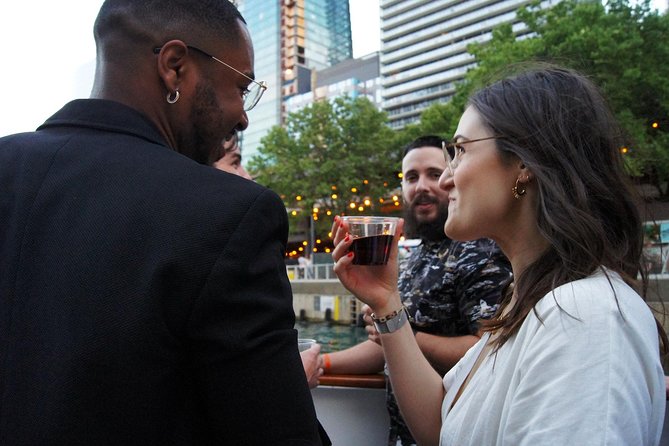
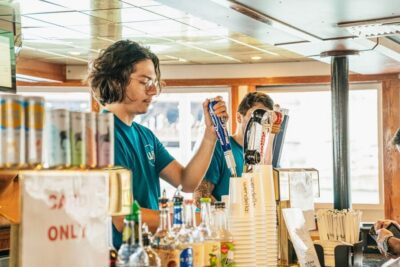
There is a full bar onboard, and drinks and light snacks are available for purchase. Several recent departures have been praised for hot chocolate, which can be a welcome choice on a cool afternoon or evening. Restrooms are available, though they close 15 minutes before the end of the cruise.
Navy Pier and the river’s changing purpose
As First Lady moves along the Chicago River, the docent connects the waterway to Navy Pier. The pier has served as a naval base, a university campus, a shipping center, and an entertainment destination.
That changing role gives you a useful lesson in adaptive reuse. Chicago did not simply preserve every old structure as a museum. It repeatedly found new uses for major pieces of its waterfront. From the boat, Navy Pier also helps you understand how the river and lakefront work together, even though the cruise is focused on the river corridor.
The view is more about setting and context than a long stop. You will see Navy Pier from the water, but this is not a shore excursion with time to explore the pier itself. If you plan to visit Navy Pier afterward, check your schedule carefully since the cruise returns to its original meeting point.
Marina City, the Trump tower, and the idea of a city in layers
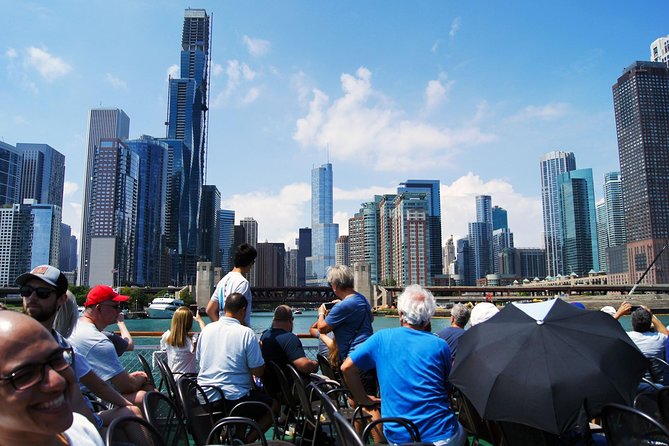
Marina City is one of the cruise’s most recognizable sights. Its rounded twin towers were designed by Bertrand Goldberg as an urban experiment. The goal was to bring middle-class residents back into the city after years of suburban migration.
From street level, Marina City can feel like an isolated pair of unusual towers. From the river, its relationship to the surrounding buildings becomes clearer. The complex was meant to combine housing and city life in a way that reduced the need to retreat to the suburbs. Your guide uses it to explain not only its shape, but also the social problem it was built to address.
The Trump International Hotel & Tower offers another useful lesson. Its reflective glass and steel exterior are only part of the story. The docent explains how the building responds to its surroundings, including the river and nearby structures. That idea of buildings being in conversation with one another came up repeatedly in the strongest tours, and it is one of the most helpful ways to look at Chicago architecture.
Instead of treating each tower as a separate object, you begin to see the riverfront as a long sequence of design decisions. Some buildings try to dominate. Others respond to old forms, water, bridges, or neighboring towers.
Same river, a completely different day on the water:
- Chicago: Architecture River Cruise Skip-the-Ticket Line
★ 4.8 · 4,325 reviews - Chicago River 45-Minute Architecture Tour from Magnificent Mile
★ 4.5 · 2,924 reviews - Chicago Lake and River Architecture Tour
★ 4.5 · 2,308 reviews - Chicago: 45-Minute Family-Friendly Architecture River Cruise
★ 4.7 · 2,304 reviews
Modernism at 330 North Wabash
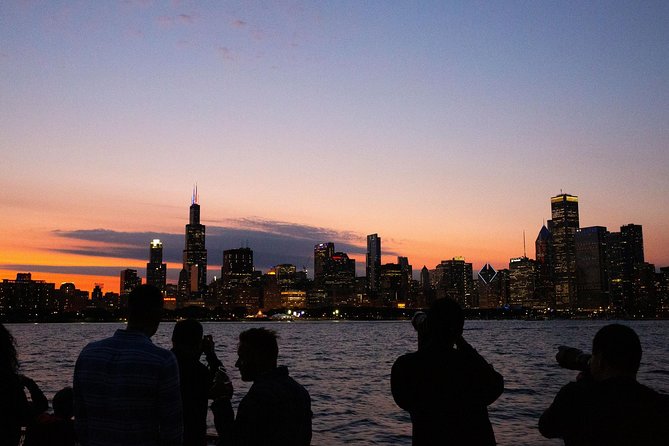
One of the last American projects designed by Ludwig Mies van der Rohe occupies a prominent place along the Chicago River. This powerful Modernist building gives the docent a chance to explain the discipline of Mies’s approach: clean lines, strong structure, and a design that does not rely on decoration.
The river offers a good viewing angle because you can take in the building’s full height and its position within the city. On foot, nearby towers and traffic can break up your view. From the boat, the building reads more clearly as part of the riverfront wall.
This is one reason the cruise is useful even if you already know a little about Chicago’s architecture. You are not merely collecting names. You are getting enough explanation to recognize why one building feels restrained, another playful, and another engineered almost as a stunt.
150 North Riverside and the engineering show
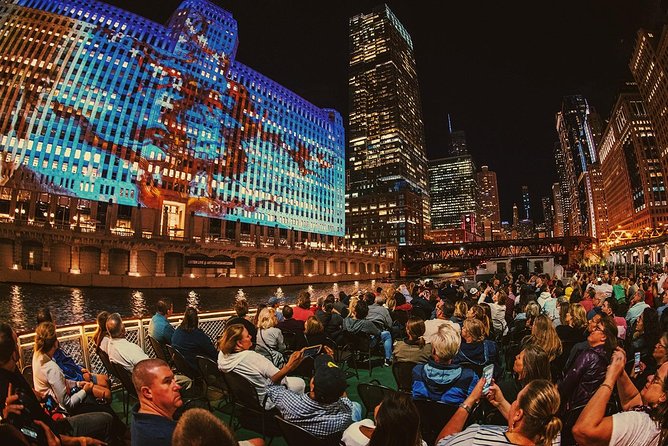
150 North Riverside is among the newer buildings on the route and one of the most visually striking. Its narrow lower section and broader upper floors create the impression that the tower is balancing above the ground.
The building gives your guide a chance to shift from architectural style to engineering. Chicago is famous for tall buildings, but height alone is not the point. The real question is how a building uses a constrained downtown site while creating enough strength and stability to support its upper floors.
You will also view the Boeing International Headquarters at 100 North Riverside Plaza. Seeing these buildings from the river helps you compare different responses to the same urban setting. The view is quick, but the commentary gives it purpose.
Willis Tower and the buildings that made Chicago famous
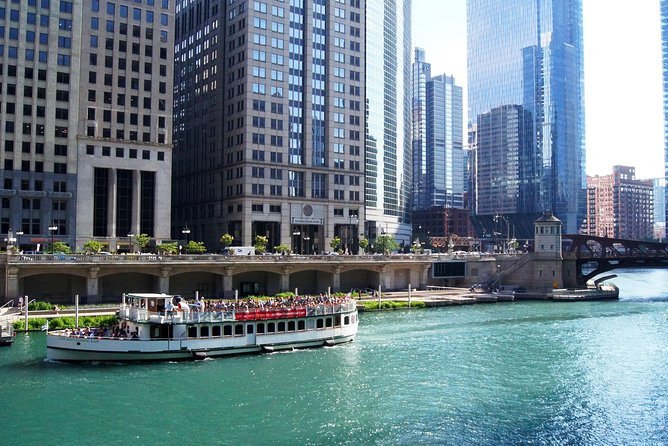
For nearly 25 years after its completion, Willis Tower, formerly known as the Sears Tower, was the world’s tallest building. From the river, its scale remains impressive, but the guide also places it in the wider story of Chicago’s race to build higher.
The tower is best understood as more than a photo opportunity. It represents a period when advances in structural design allowed architects to push beyond the limits of the standard skyscraper. The river view lets you compare Willis Tower with newer buildings that use different shapes, materials, and engineering systems.
Another stop is the old Marshall Field’s wholesale warehouse, completed in 1930. At the time, it was the largest building in the world. Retailers came there to buy stock, so its size was tied to the commercial machinery of the Midwest, not just to architectural ambition.
This stop is a helpful reminder that Chicago’s impressive buildings were not all designed as offices or luxury residences. Some were warehouses, trading centers, factories, or transportation facilities. The city’s architecture grew from business needs as much as from artistic vision.
The Mercantile Exchange and Chicago’s working core
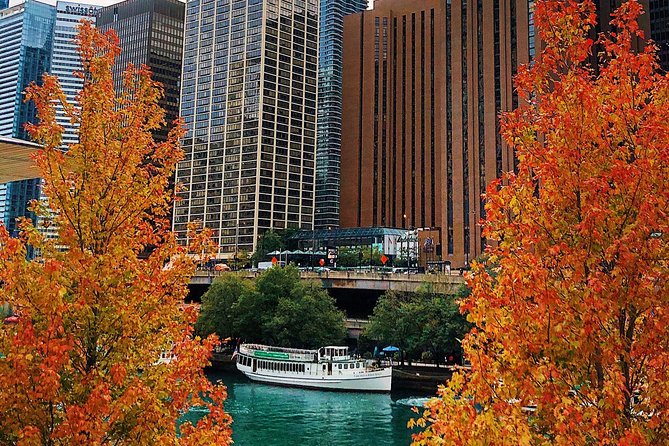
The Chicago Mercantile Exchange Building at 20 South Wacker Drive represents another part of the city’s economic story. The riverfront view places it among the offices and towers that support Chicago’s role as a major center for commerce.
The Chicago Tribune Freedom Center adds another layer. Its presence helps show that the river corridor is not only a collection of high-rise office buildings. Printing, publishing, trade, shipping, and media all played roles in shaping this stretch of the city.
The exact route, vessel, and schedule can change without notice. That is worth accepting before you book. The core value remains the guided river view, but you should not treat every listed building as a guaranteed close pass on every departure.
What the 90 minutes feels like
The cruise is long enough to feel substantial but short enough to fit into a busy Chicago day. The 90-minute format works especially well for a first day because it gives you history, architecture, and orientation without taking over your schedule.
The guide speaks live throughout the cruise. The best presentations combine facts about architects and buildings with stories about bridges, the river, city planning, and the people who used these spaces. Recent guides have included Cynthia, Laura, Amy, Russell, Nick, and Mark, though no particular guide is guaranteed.
The strongest guides keep the pace lively and explain technical ideas in plain language. That matters because a nonstop list of building names would quickly blur together. The most useful moments come when the docent explains how a structure connects to its neighbors or why a certain design solved a specific city problem.
Evening departures can be especially appealing. The buildings take on a different character as daylight fades, and the river gives you a clear angle on the illuminated skyline. Daytime departures are better if your priority is photographing architectural details. Either way, clouds, wind, and shade can affect the experience, so dress for the forecast rather than the season alone.
The boat can carry up to 250 people. That is a sizable group, but the boat is described as spacious and comfortable, and seating is spread between two levels. If quiet sightseeing is your priority, choose an early arrival and consider a less busy departure time if your schedule allows.
Is $57 a fair price?
At $57 per person, this is not the cheapest way to see Chicago. You are paying for a 90-minute boat ride, live commentary, a trained Chicago Architecture Center docent, indoor and outdoor seating, and the chance to see a large part of the riverfront without walking several miles.
The price makes sense if you value explanation. A basic boat ride might show you the same skyline, but it may not explain why Marina City was built, how Willis Tower changed skyscraper design, or how the river shaped the city’s growth.
For a short Chicago visit, I consider the cruise a good use of money because it combines orientation and sightseeing. It can also help you decide which buildings and neighborhoods deserve more time afterward. The $5 discounted admission to the Chicago Architecture Center adds a useful follow-up option directly across Wacker Drive.
The value is weaker if you mainly want a quiet ride or a long trip beyond the central river corridor. One recent assessment found the route did not travel as far as expected, and that is a fair caution. This is a focused downtown architecture cruise, not a broad tour of every part of Chicago.
Practical details that can affect your day
The tour operates in all weather. The lower salon has climate control and large windows, so rain does not automatically ruin the outing, but you should still bring suitable clothing. Cold air and shade can make the open deck uncomfortable, while bright sun can interfere with building views.
Luggage is not allowed onboard, and there is no dockside storage. Leave suitcases at your hotel. Service animals are allowed, but pets are not. Strollers can come onboard, though children must be removed during boarding, and the stroller will be folded and stored in the salon.
Children must be accompanied by an adult, and the experience is not recommended for children younger than 12. Older children who like buildings, city stories, or boats should have plenty to follow, especially if the guide keeps the presentation lively.
The cruise is offered in English. Most people can participate, but remember the stair access to the dock and the lack of an elevator. The ticket is non-refundable and cannot be transferred to another departure, so choose your time carefully.
Who should book this Chicago river cruise?
I would book it early in a Chicago visit if you want a clear introduction to the city’s architecture and history. It suits couples, friends, solo visitors, families with older children, and anyone who wants strong views without a long walking route.
It is also a good choice for architecture fans who want more than photographs. The guides explain design, engineering, commerce, and city planning, giving you reasons to look at buildings differently after the boat returns.
I would hesitate only if you need assigned seating, cannot manage stairs to the dock, are carrying luggage, or want a flexible ticket. If you prefer to wait for perfect weather, remember that the cruise runs rain or shine and changes are not allowed.
For most people, the call is easy: book the Chicago Architecture Center River Cruise aboard First Lady, arrive early, dress for the elements, and aim to take it near the start of your Chicago stay. The skyline is the hook, but the city’s story is the real reason to go.
FAQ
Where does the Chicago Architecture Center River Cruise depart?
It departs from the Chicago Riverwalk dock at 112 East Wacker Drive. The entrance is at street level near the northeast corner of Michigan Avenue and Wacker Drive.
How early should I arrive?
Arrive 30 minutes before departure. Allow extra time during summer, when the area can be busier.
Is seating assigned?
No. All seating is general admission, and boarding is first come, first served. Any seat numbers printed on your ticket are not valid.
What happens if it rains?
The cruise operates in all weather. The boat has an open-air upper deck and an enclosed, climate-controlled lower salon with large windows.
Can I buy food or drinks onboard?
Yes. A full bar is available, and drinks and light snacks can be purchased onboard.
Are restrooms available?
Yes. Restrooms are onboard, but they close 15 minutes before the end of the cruise.
Can I bring luggage?
No. Luggage cannot be brought onboard, and there is no storage area at the dock. Leave luggage at your hotel.
Can I bring a stroller or service animal?
Strollers are allowed, but children must be removed during boarding. The stroller will be folded and stored in the salon. Service animals are allowed, but pets are not.
Just added around Chicago
- Chicago River Sunday Funday Mimosa or Bloody Mary Party Cruise★ 4.0 · 18 reviews
- City Cruises Chicago: River Architectural Lunch Cruise★ 4.5 · 39 reviews
- Chicago By Night River & Lake Cruise★ 4.5 · 236 reviews
- Chicago River Architecture Tour Aboard a Historic Yacht★ 5.0 · 45 reviews
- Historical and Architectural Chicago Fireboat River & Lake Cruise★ 5.0 · 246 reviews
- Chicago River Cocktail Cruise★ 4.5 · 86 reviews
- Chicago River Architecture Tour and Big Bus Hop-on Hop-off Tour★ 4.0 · 38 reviews
- Magnificent Mile Tour With Optional 360 Chicago Upgrade★ 5.0 · 80 reviews
Chicago River Cruises, compared.
Chicago River: 1.5-Hour Guided Architecture Cruise
Read our review →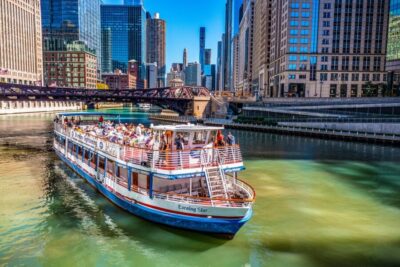
Architecture River Cruise Skip-the-Ticket Line
Read our review →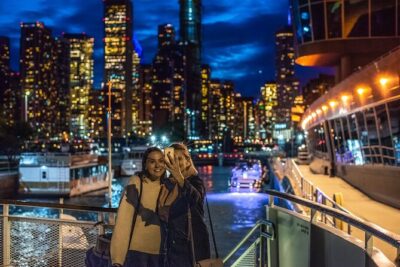
Chicago River 45-Minute Architecture Tour from Magnificent Mile
Read our review →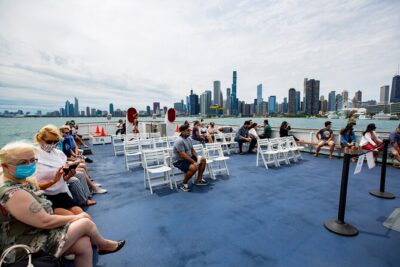
45-Minute Family-Friendly Architecture River Cruise
Read our review →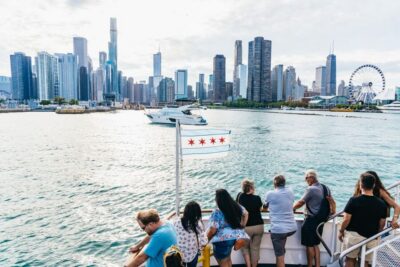
Browse the lists this tour appears in