
REVIEW · HO CHI MINH CITY
1 Hour Saigon River Tour in Ho Chi Minh
Ho Chi Minh City looks different from the water. In one hour, this small-boat cruise takes you past French colonial buildings, modern towers, working port areas, bridges, canals, and the changing skyline of District 2. I like the short, useful format and the chance to see the city without fighting traffic.
I also like the small boat and live English commentary. Guides such as Will have been praised for explaining both Saigon’s past and its fast-changing future. The main drawback is the seating: depending on where you sit, you may face away from the city or need to turn around for the best views. The river itself can also look muddy and industrial rather than postcard-pretty.
Key things to know before boarding
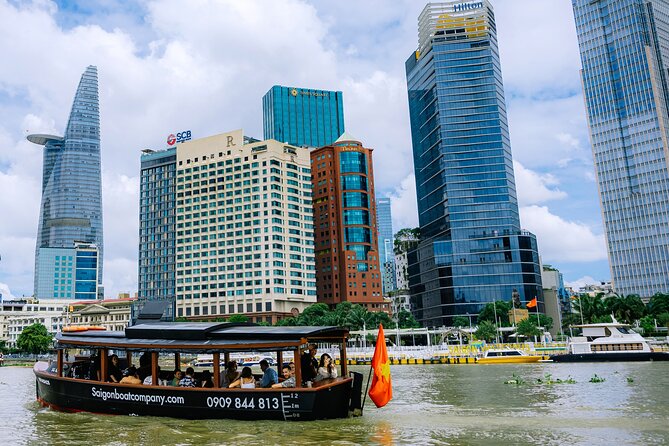
- The one-hour route covers central Saigon: You cruise beside District 1 and District 4, then toward Thu Thiem and several major bridges.
- Evening departures are especially photogenic: Illuminated towers and bridges give the city a fresh look after dark.
- The boat has a sliding roof: This helps with Ho Chi Minh City’s strong sun and sudden rain.
- The guide adds real context: Commentary covers Vietnamese history, river commerce, architecture, and urban development.
- The ride is small and informal: The boat holds a maximum of 20 people, though some departures may feel crowded.
- Food and drinks cost extra: You can buy refreshments on board, including beer and soft drinks.
What this Saigon River cruise is really like
This is not a long sightseeing voyage into the countryside. It is a compact city cruise designed to fit into a busy Ho Chi Minh City schedule.
You begin at Bạch Đằng Waterbus Station on the riverfront in District 1. From there, the boat moves along the central Saigon River, giving you a broad view of the city’s older riverfront and newer high-rise development. The ride is gentle and usually relaxed, with a guide pointing out landmarks as they come into view.
For me, the value lies in the change of pace. Ho Chi Minh City traffic can be tiring, especially in the heat. An hour on the river gives you a cool breeze, a seat, and a chance to see how the city grew around its waterways.
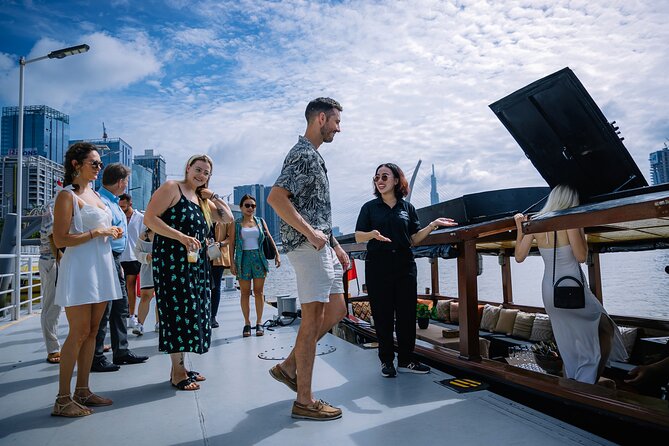
The boat is described as a luxury vessel, but it is still a small sightseeing boat rather than a large dinner cruise. That is mostly an advantage. A smaller boat feels more personal, and the maximum group size is 20 people. Still, the seating arrangement can limit your view. Some passengers sit in long rows along the sides, and not every seat faces the skyline.
Try to arrive with a little time to choose a position. If you care about photography, you may want a seat with a clear side view rather than one directly behind the captain. You can also move your attention from one side to the other as the boat turns, but some landmarks pass quickly.
A few more river trips around Ho Chi Minh City worth comparing
- Paris: 1-Hour Seine Cruise departing from the Eiffel Tower
★ 4.4 · 77,472 reviews - Seville: 1-Hour Guadalquivir River Sightseeing Eco Cruise
★ 4.2 · 10,281 reviews - Frankfurt: 1-Hour Panorama Boat Cruise on the river Main
★ 4.4 · 1,822 reviews
The route from Bạch Đằng to the central riverfront
The cruise begins near Bạch Đằng, one of the most useful places in central Ho Chi Minh City to get close to the Saigon River. The first part gives you a sense of the city’s unusual mix: colonial-era structures near sleek towers, commercial river traffic alongside tourist boats, and old neighborhoods facing large construction projects.
You’ll pass areas beside District 1 and District 4. District 4 sits between the Saigon River and two canals and is one of the city’s densest districts. From the water, its compact urban form is easier to understand than it is from street level.
The Ben Nghe Channel is another important feature along the route. It once served as a center of commerce because of its position near the river. The channel also helps explain why waterways mattered so much to Saigon’s growth. The city was not simply built beside the river for scenery. The river was a route for trade, shipping, and communication.
The commentary can make this section more rewarding. Without explanation, you may mainly see towers, bridges, and boats. With the guide’s help, those sights connect to the city’s economic and political story.
Colonial buildings near Dong Khoi Street
One of the early landmarks is the historic hotel at 1 Dong Khoi Street. Built in 1925 in a French Riviera style, it reflects the architectural period when central Saigon was shaped by French colonial planning and wealthy commercial interests.
The river view does not give you the same close look you would get walking Dong Khoi Street. Still, seeing the building as part of the waterfront district helps place it within the city’s older center.
The boat also points out the Tran Hung Dao statue. Tran Hung Dao was a Vietnamese prince, statesman, and military commander who lived from 1231 to 1300. He is remembered for defeating Mongol invasions, making the statue more than a decorative landmark. It connects the modern riverfront with an earlier period of Vietnamese history.
Nguyen Hue Boulevard runs from the Saigon River toward City Hall. It is one of central Saigon’s main pedestrian spaces, and the river end provides a useful reference point for understanding the city center. From the boat, you see the boulevard as part of a larger axis linking the waterfront with the civic heart of Ho Chi Minh City.
The old port, customs house, and river trade
The route includes several buildings tied to Saigon’s role as a port city.
The flagpole began as a signal mast for incoming ships. The original was built in 1865, while the current version dates from 1900 and carries the Vietnamese flag. It is a small feature compared with the towers around it, so the guide’s explanation matters here. You could easily miss its purpose without context.
The customs building was originally built in 1867 as a mansion for a wealthy businessman. It was converted to its present use in 1881 and now serves as the headquarters of the customs department. This is a good example of how buildings along the river have changed function while remaining tied to commerce.
Another stop is a former Banque de l’Indochine building, constructed in 1928. It now houses the Ho Chi Minh City branch of the State Bank of Vietnam. These sights are not dramatic in the way a cathedral or palace might be, but they help explain the financial and administrative importance of the riverfront.
You’ll also pass one of Saigon’s oldest bridges, built by the company once led by Gustave Eiffel. The bridge is a reminder that the city’s transport network was shaped by engineering projects as much as by grand civic buildings. Depending on the light and your seat, it can make a good photograph, though the boat does not stop for extended viewing.
Same river, a completely different day on the water:
- From HCM City: Mekong Delta Tour with Sampan Journey
★ 4.5 · 13,132 reviews - Cu Chi Tunnels and Mekong Delta Signature Tour
★ 5.0 · 7,328 reviews - Mekong Delta Guided Tour from Ho Chi Minh City
★ 4.5 · 7,192 reviews - Cu Chi Tunnels and Mekong Delta Full Day Tour – Max 12
★ 5.0 · 6,257 reviews
Thu Thiem Tunnel and the changing city
The cruise then brings you toward newer parts of Ho Chi Minh City, including the Thu Thiem Tunnel. Opened as part of an important highway, it is the first and only tunnel under the Saigon River.
From the boat, the tunnel entrance is more meaningful as a piece of city planning than as a visual spectacle. It shows how Ho Chi Minh City continues to build transport links beneath and across the river as development spreads east.
The route also passes an old building dating from 1862. It once served as the original port and now houses the Ho Chi Minh Museum. This gives you an interesting contrast: the riverfront has been a place of arrival, trade, government, and memory for generations.
District 4 comes into view near the Saigon port. The district is densely settled and sits in a tight space between waterways. The port area may look industrial, and the river can appear dirty in places. That is worth knowing before you book. This is an urban working river, not a pristine nature cruise.
For me, that is part of the experience. You see the real edge of the city, including shipping activity, older buildings, and infrastructure. If you want only polished skyline views, an evening departure near the central towers will probably suit you better.
Thu Thiem, Ba Son Bridge, and the skyline
Thu Thiem was once largely undeveloped swamp. It is now planned as one of Ho Chi Minh City’s major new urban districts, with residential areas, offices, and large parks.
The river gives you one of the clearest ways to see this change. On one side, central Saigon has established towers and colonial buildings. On the other, Thu Thiem represents the city’s future. Construction and open areas may dominate parts of the view, so do not expect every stretch to look finished.
Bitexco Tower is one of the most recognizable buildings on the route. Completed in 2010, it was once the tallest skyscraper in Vietnam. Its shape was inspired by the lotus, Vietnam’s national flower. From the water, the building’s unusual form is easier to appreciate because you see it against the open sky rather than squeezed between neighboring towers.
You’ll also see another major skyscraper associated with national and international companies and Vietcombank. The route includes a historic riverside building that houses the Southern Naval Command Office, adding another layer to the mix of commercial, military, and civic uses along the river.
Ba Son Bridge is a newer addition to the crossings over the Saigon River. It takes its name from the Ba Son Shipyard, an important part of the river’s industrial identity. The bridge is especially attractive after dark, when its lighting gives the evening cruise a stronger visual payoff.
The tallest tower in Vietnam is also part of the wider skyline view. Seeing it from the river gives you a better sense of its scale than a street-level view often does. The former bridge that once provided the only central connection to District 2 also appears along the route. Until 2008, it was a vital gateway between the city center and the eastern side of the river.
The historic temple and the river’s quieter side
Not every sight is a tower or bridge. The cruise passes a temple on the Saigon River bank, one of the few old buildings still surviving in Thu Thiem.
This is one of the more interesting contrasts on the route. The temple sits within an area being transformed by offices, apartments, roads, and parks. Its presence shows that urban renewal does not erase every earlier layer, even when the surrounding district changes quickly.
The boat’s route does not turn the temple visit into a walking stop. You see it from the water, and the view may be brief. That is typical of this cruise: it is an overview, not a series of shore excursions. If you want to enter historic buildings or explore neighborhoods on foot, pair the boat ride with a separate walking tour.
Afternoon or evening: which departure works best?
The tour offers several afternoon and evening departures, so you can fit it around sightseeing in District 1.
An afternoon ride gives you clearer views of buildings and river activity. It is a good choice if you want to understand the layout of the city, study the older architecture, and take daytime photographs. The sliding roof is useful at this time, especially under strong sun.
An evening ride changes the mood. The skyline lights up, and bridges such as Ba Son Bridge can look striking from below. The city becomes less about architectural detail and more about reflections, illuminated towers, and the river breeze.
A sunset departure can offer the best of both, although the exact light depends on the day and weather. The cruise requires good weather, and poor conditions can lead to a different date or a full refund.
The night option has received especially strong praise for its skyline views and the chance to see an illuminated bridge from underneath. Just remember that low light makes photography harder, particularly from a moving boat.
Comfort, refreshments, and the guide
The boat has a restroom, which is a useful feature even on a one-hour ride. Drinks and snacks are available for purchase, including beer and other refreshments. Food and drinks are not included in the ticket price, so bring that expectation with you.
The sliding roof protects you from rain and sun, but it may also affect your sightline. If the roof is closed, you can still see out, though the experience feels less open. The river breeze is one of the pleasant parts of the trip, so a dry, comfortable evening is ideal.
The live guide is central to the experience. Commentary covers landmarks, Vietnamese history, the importance of the river, and the city’s future development. Guides have received praise for being friendly and willing to answer questions. Will is one guide whose explanations have been singled out positively.
English quality can vary by guide and departure. Most of the feedback is positive, but some passengers have found the commentary difficult to follow. If you want detailed historical interpretation, keep your expectations moderate. This is a sightseeing cruise with explanation, not a specialist history lecture.
Seating, crowding, and the diesel issue
The boat holds up to 20 people. That keeps the group fairly small, but a full departure can feel crowded because the seats run along the sides. One practical issue is that some seats face away from the city, forcing you to turn for views.
There has also been a complaint about diesel fumes near the captain’s position. This may depend on wind direction and where you sit, but it is worth avoiding the rear or captain’s area if you are sensitive to engine smells.
Departure is intended to be on time, although an occasional delay can happen if the boat waits for late arrivals or last-minute purchases. You should still arrive at the stated meeting point, Bạch Đằng Waterbus Station, with enough time to board calmly.
Is $12.50 good value?
At $12.50 per person, this is a reasonably priced way to add a river perspective to a Ho Chi Minh City visit. You get about an hour on the water, a captain, an English-speaking guide, a covered boat, and access to a restroom. Refreshments cost extra, but you are not required to buy anything.
The price works best when you treat the cruise as an introduction to the city rather than a full sightseeing day. You are paying for a different viewpoint and a short break from the streets. You are not paying for a long river journey, a meal, or close access to every landmark.
I think the value is strongest for first-time visitors, people with limited time, and anyone who wants a relaxed evening activity. It is less suitable if you expect grand scenery for the full hour or want to step ashore at historic sites.
Free cancellation is available up to 24 hours before departure. Changes or cancellations inside that period are not refunded, and poor weather may lead to a new date or full refund.
Who should book this boat ride?
Book it if you want a low-cost city overview without committing half a day. It is also a good choice after a busy day of walking, when an hour of river air sounds better than another crowded street.
Families and older visitors may appreciate the short duration, seating, roof, and restroom. Couples may prefer an evening departure for the illuminated skyline. Photographers should choose their departure carefully and think about seating before the boat fills.
Skip it if you want untouched scenery, a long trip beyond the city, or a detailed visit inside historic buildings. The river can look muddy, some views are distant, and the seating is not perfect.
For most people, I would book the evening cruise if the weather looks good. You get the city lights, bridges, and towers at their best, while the guide gives you enough context to understand what you are seeing. At one hour and $12.50, it is a sensible add-on, not a substitute for exploring Ho Chi Minh City on foot.
FAQ
How long is the Saigon River tour?
The cruise lasts approximately one hour.
Where does the tour start?
It starts at Bạch Đằng Waterbus Station, Bến Nghé, District 1, Ho Chi Minh City.
Where does the boat tour end?
The tour ends back at the same meeting point.
Are food and drinks included?
No. Food and drinks are available to purchase on board.
Does the boat have a roof?
Yes. The boat has a sliding roof that can help protect you from sun or rain.
Is there a restroom on board?
Yes. A restroom is available on the boat.
What happens if bad weather cancels the cruise?
If the experience is canceled because of poor weather, you will be offered another date or a full refund.
Just added around Ho Chi Minh City
- Top Home Cooking Class with Stunning River View AC Kitchen★ 5.0 · 25 reviews
- Small Group Full-Day Cu Chi Tunnels and Mekong Trip★ 4.6 · 64 reviews
- Small Group tour to Mekong Delta 1 Day (Maximum 12pax)★ 4.4 · 17 reviews
- Ho Chi Minh City: Mekong Delta Day Trip with Lunch★ 4.3 · 15 reviews
- From Ho Chi Minh: Mekong Delta Private Day Tour★ 4.7 · 18 reviews
- Mekong Delta 2 Days: Floating Markets & Cultural Exploration★ 4.7 · 84 reviews
- Mekong Day Tour by Car:Cai Be market, Local Island & Cycling★ 4.8 · 33 reviews
- Hochiminh: Best tour Mekong Delta 1 Day★ 4.1 · 10 reviews
Ho Chi Minh City River Cruises, compared.
Cu Chi Tunnels and Mekong Delta Signature Tour
Read our review →
Mekong Delta Guided Tour from Ho Chi Minh City
Read our review →
Cu Chi Tunnels and Mekong Delta Full Day Tour – Max 12
Read our review →
Full-Day Cu Chi Tunnels and Mekong Delta Tour
Read our review →
HCM: Mekong Delta, My Tho & Ben Tre Coconut Village
Read our review →
CuChi Tunnels&Mekong Delta-Boat,TukTuk,Coconut Village SmallGroup
Read our review →
Adventure Cu Chi Tunnels and Mekong Delta Tour From HCM
Read our review →Browse the lists this tour appears in